




India is home to one of the most extensive and richly diverse living systems of traditional medicinal knowledge, including Ayurveda, Siddha, Unani, and numerous other community-based and indigenous healing practices. As global healthcare faces increasing barriers associated with chronic disease burden, antimicrobial resistance, climate-related health risks, biodiversity loss, and unequal access to care, the scientific value of traditional medicine has never been greater. For these systems to make meaningful contributions to modern healthcare and global bio-economies they will need to be scientifically proven, ethically regulated, sustainably sourced and digitally enabled.
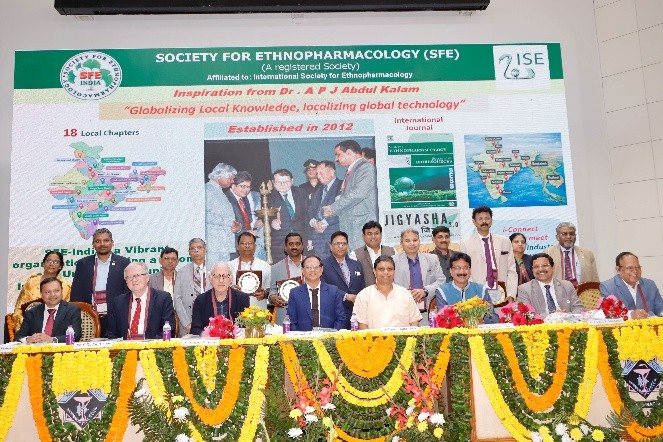
Over the past fourteen years, the Society for Ethnopharmacology, India (SFE-India), has evolved into an internationally recognized and respected organization promoting Ancestral Medical Wisdom, combined with contemporary scientific standards. Founded in 2012 by Professor Pulok Kumar Mukherjee based on the values of former Indian President Dr. APJ Abdul Kalam; SFE-India’s central tenet is that Traditional Knowledge Systems and Modern Biomedical Science can not compete with one another; rather they should work collaboratively using evidence, ethics, and partnership.
SFE India developed over time from being an academic group to be a systems level system that brings together all the different stakeholders in ethnopharmacology, such as traditional practitioners, researchers, clinicians, policy makers, industry leaders, students, and organizations globally. The Society established through its various programs the Traditional Healer’s Meet, the i-Connect Business Meet, the SESB Journal, the Jigyasha Student Engagement Program and Webinar Series on National and International levels. All these platforms were designed to provide sustainable ways for dialogue among stakeholders, documentation of practices, validation of scientific evidence, translational research for application by entrepreneurs or industries, and finally engaging with policy makers.
The Traditional Healers’ Meeting is a foundational program for SFE-India since 2012 and provides a respectful, inclusive and ethical forum for acknowledging healers as guardians of the existing body of living medical knowledge. This meeting fosters documentation/scientific validation/benefit sharing/translational research and supports the conservation/sustainability of medicinal bio-resources. To complement this initiative, SFE-India’s i-Connect Business Meeting which began in 2023 fills the long standing gap between research conducted within academic environments and commercialization by providing entrepreneurs/small-to-medium-sized enterprises/companies with means to convert ethnopharmacological knowledge into commercially viable products/products that can compete globally with respect to national missions such as Viksit Bharat and Atmanirbhar Bharat.
Capacity building and the establishment of future leadership is a key focus area for SFE-India. In this regard Jigyasha provides students and early career researchers with the opportunity to develop scientific inquiry skills; interdisciplinary thinking; social responsibility/ethics awareness; and practical experience in ethnopharmacology beyond their textbooks. Similarly the SFE-India Webinar Series serves as a year round global classroom that democratically enables participants to engage with expertise across all aspects of ethnopharmacology, sustainability, regulatory science, artificial intelligence/translational research.
With recognition that the study of traditional medicine is becoming increasingly complex in terms of research methods, SFE-India advocates for systems ethnopharmacology; One Health; Planetary Health; and responsible use of artificial intelligence. Artificial Intelligence is viewed by SFE-India as an enabler for literature mining/systems pharmacology/prediction of potential side effects/digital tracking/tracing under the guidance of ethics/data sovereignty/alignment with frameworks such as the CBD/Nagoya Protocol/FAIR/CARE/Sustainable Development Goals (SDGs).
As well as maintaining a very large national network of chapters through its Official Journal SESB, SFE-India has significantly enhanced India’s role as a leader in evidence based research into traditional medicine at the national level. Additionally, SFE-India’s efforts have contributed directly to priority areas for national/international policy-making; including AYUSH Integration; WHO Traditional Medicine Strategy; Biodiversity Conservation; Sustainable Bio-Economy Development; and Healthcare Innovation that is equitable/inclusive.
This White Paper outlines SFE-India’s journey/philosophy/impact/future vision (2025 – 2030). The document identifies SFE-India as a trusted scientific/ethical/translational partner for governments, global agencies, academia, industry, communities wishing to responsibly incorporate traditional medicine into modern healthcare systems/sustainable development frameworks.
SFE-India is not simply protecting our cultural heritage. Rather it is actively developing a new generation of healthcare solutions where the best of traditional wisdom meets the best of scientific integrity and entrepreneurial courage resulting in credible healthcare solutions that are accessible, socially just and environmentally sustainable.
Understanding Medicines Through Culture, Science, and Nature
Ethnopharmacology is a scientific discipline that investigates how people throughout the world use natural sources for their physical and mental well-being. This area of study links ancient knowledge to modern pharmaceutical practice by applying ethnocultural insight into the mechanisms of action in laboratory experiments, clinical trials, and systemic studies.
Ethnopharmacologists ask the basic questions of both scientists and anthropologists; they want to know about medicinal plant identification and development from generation to generation, which bioactive compounds are responsible for observed therapeutic effects, how traditional formulations work at the molecular, cellular, and system levels in humans, and if these remedies are safe, effective, reproducible, and environmentally sustainable for widespread use.
A Truly Interdisciplinary Science
Ethnopharmacology is inherently interdisciplinary in nature. It integrates knowledge and methodologies from multiple scientific and social disciplines, including:
• Pharmacology and toxicology
• Botany, phytochemistry, and natural product research
• Anthropology and ethnobotany
• Systems biology and network pharmacology
• Clinical research and real-world evidence generation
• Sustainability science, ecology, and biodiversity conservation
Ethnopharmacologists study how humans use plant-based medicines in their communities by employing a multidisciplinary approach. This multidisciplinary approach is necessary to allow for the accurate representation of medicinal systems that are based upon using multiple components to treat diseases through multiple mechanisms (as opposed to treating disease with one molecule). In other words, ethnopharmacologists attempt to understand how people, plants, and cultures work together as they develop and utilize medicines. To do this, they apply scientific methods to assure safety, efficacy, reproducibility, and long-term sustainability.
Traditionally, India has been home to a wide variety of medicinal plant species and traditional medical practices for many thousands of years. Traditional medicine systems include Ayurvedic Medicine; Unani Medicine; Siddha Medicine; Tribal Healing Traditions and Community Based Healing Practices. These systems have maintained public health through an understanding of the relationship between people, nature and disease. Even today, traditional healers are maintaining their position as the “keepers” of this valuable information in rural areas or areas with limited access to modern health care.
While many of these traditions have great importance in terms of their healing and cultural values, however, many are at present being challenged by modern issues. Most of these knowledge bases remain to be orally passed down and as such lack written documentation, validation within the context of modern science and regulation and ethical approval. Therefore, if not systematically documented, scientifically validated, ethically integrated into the broader system of health care, there is a potential for loss of potentially useful traditional knowledge base and/or its misappropriation or exclusion from mainstream health care systems.
Ethnopharmacology is an important tool for bridging this gap by using traditional wisdom and science-based methods to validate ethnomedicinal remedies, enable the development of new medicines and formulations, support the conservation of medicinal plant diversity and protect traditional knowledge systems.
Ethnopharmacology can also serve as a means through which affordable, culturally relevant and environmentally sustainable health care options are developed to address several current global public health issues including increasing rates of chronic disease, growing antimicrobial resistance, loss of biodiversity, changes in climate and inequities in health care delivery.
Ethnopharmacology is important today because it has potential in developing the following areas:
- The basis for an evidence based verification of the use of traditional medicine
- A source for new drugs, formulations and translation of this work into clinical practice
- Encourages the use of medicinal plants in a way that promotes their preservation and sustainability.
- Protects the rights of indigenous peoples to knowledges of plants traditionally used by them through development of ethical guidelines
- Provides information that can be used in the development of public health policy, regulation and standards at a global level.
Through the integration of ancient knowledge with modern science, ethnopharmacology provides the opportunity for traditional medicines to evolve from historical relics to a contemporary and evolving science.
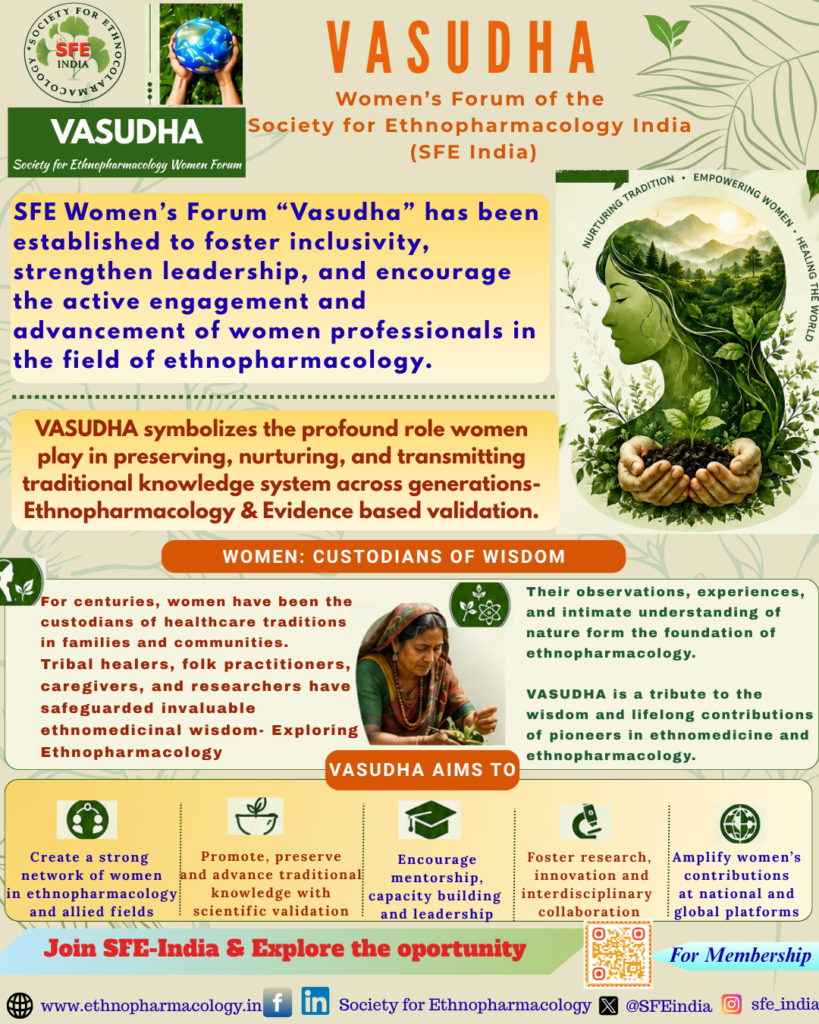
VASUDHA SFE's Women Forum
Gallery