About the Journal Vision Bridging Knowledge Aims & Scope Thematic Highlights Why Publish Editorial Leadership Global Editorial Network Looking Forward Call for Submissions
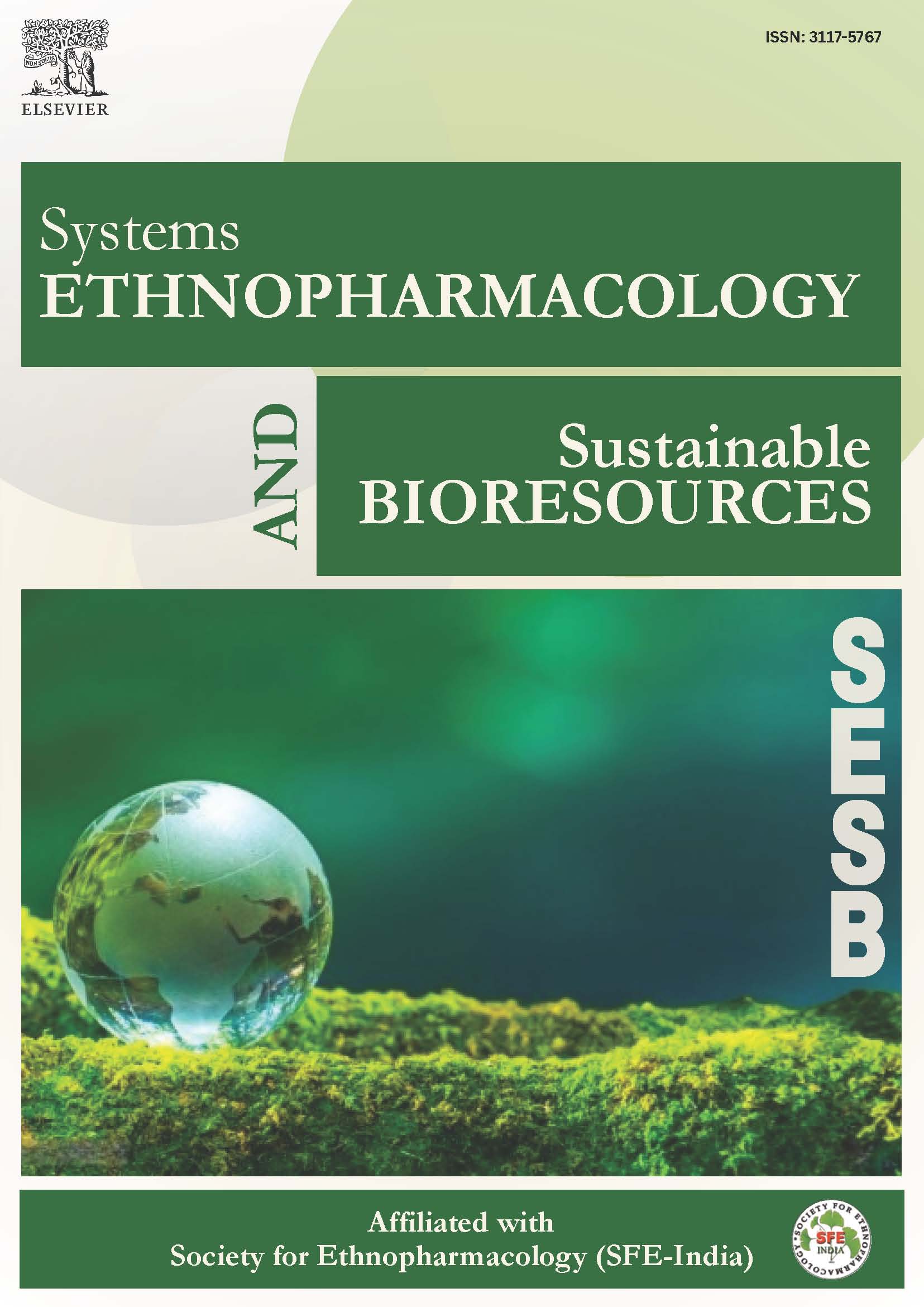
Systems Ethnopharmacology and Sustainable Bioresources (SESB) is an international, peer-reviewed journal dedicated to advancing research at the intersection of ethnopharmacology, sustainability science, ecological stewardship, and modern pharmacology through a systems-thinking lens. It’s a first-of-its-kind international journal dedicated to holistic, evidence-based and sustainability-aligned research.
The journal promotes a holistic understanding of how medicinal plants, natural products, traditional knowledge systems, and traditional practices operate within dynamic biological, ecological, socio-economic, and cultural contexts that shape human and planetary health. SESB aligns with global sustainability priorities, including the United Nations Sustainable Development Goals (SDGs), and encourages rigorous, ethical, and community-cantered research that strengthens both scientific credibility and ecological responsibility
SESB is the official journal of the SFE-India and serves as its primary scholarly platform for globally relevant, ethically grounded, and interdisciplinary research on traditional medicine, natural products, and sustainable bioresources. The journal translates SFE-India’s long-standing vision into peer-reviewed, internationally visible science, strengthening the credibility and global relevance of ethnopharmacology..
A Vision for the Future
Traditional knowledge, sustainability science, and AI-enabled discovery are no longer parallel pursuits. They are increasingly convergent. SESB provides the scientific and ethical foundation for this convergence by moving beyond reductionist pharmacology and embracing systems thinking.
The journal recognizes that medicinal plants and traditional practices operate within dynamic biological networks, ecological systems, livelihoods, and cultural contexts. By aligning with the United Nations SDGs, SESB positions health research within a broader framework of planetary health, environmental responsibility, and societal well-being.
Bridging Ancient Wisdom and Modern Science
SESB fosters interdisciplinary dialogue among researchers, traditional and Indigenous knowledge holders, healthcare professionals, conservation practitioners, policymakers, and industry stakeholders. The journal reflects SFE-India’s core mission: to globalize local knowledge and localize global technologies, while safeguarding ethics, biodiversity, intellectual property, and equitable benefit-sharing.
SESB is not merely affiliated with SFE-India. It is a direct extension of the Society’s intellectual, ethical, and sustainability commitments, articulated through rigorous, peer-reviewed scholarship.
Aims and Scope
SESB welcomes original research articles, systematic reviews, meta-analyses, perspectives, commentaries, short communications, methodological advances, and policy-oriented studies that:
- Integrate biological, chemical, ecological, computational, and social sciences with traditional and Indigenous knowledge systems
- Advance sustainable healthcare, biodiversity conservation, and culturally grounded innovation
- Apply systems biology, network pharmacology, metabolomics, proteomics, cheminformatics, and AI-driven discovery
- Promote transparent, responsible, and traceable value chains for medicinal plants and bioresources
- Address global governance frameworks, including the CBD, Nagoya Protocol (ABS), CARE Principles, and data sovereignty
- Strengthen ethical governance, community engagement, and fair benefit-sharing
SESB explicitly encourages research that bridges science, culture, ecology, technology, and policy, with strong methodological rigor and ethical clarity.
Thematic Highlights
The journal covers a broad yet integrated scientific landscape, including:
- Ethnopharmacology and traditional medicine systems
- Sustainable bioresource management and conservation
- Community knowledge, equity, and benefit-sharing
- Systems thinking, One Health, and Planetary Health
- Natural product discovery, validation, and mechanisms
- Phytochemistry and bioactive compounds
- Quality, safety, formulation, and regulatory science
- Digital, AI-enabled, and data-driven ethnopharmacology
- Biotechnology, biomanufacturing, and circular bioeconomy
- Marine and microbial bioresources
- Ethnoveterinary medicine
- Nutrition, nutrieconomy, and preventive health
- Climate change adaptation and resilient bioresources
- Anthropology, social science, and knowledge transmission
Why Publish in SESB?
Publishing in SESB equate:
- Commitment to scientific rigor and reproducibility
- Explicit engagement with ethics, sustainability, and governance
- Respect for traditional and Indigenous knowledge systems
- Contribution to policy-relevant and globally aligned science
- Visibility within interdisciplinary and international research communities
SESB embeds ethnopharmacology within systems science, climate research, bioeconomy, and planetary health discourse, extending impact beyond disciplinary boundaries.
Editorial Leadership
Editor-in-Chief: Prof. Pulok Kumar Mukherjee
Jadavpur University, Kolkata, India
Under the Editor-in-Chief, Prof. Pulok K Mukherjee’s leadership, SESB emphasizes scientific rigor, interdisciplinary integration, and ethical responsibility. The journal’s editorial direction reflects a balanced commitment to traditional knowledge systems, modern pharmacological science, and sustainability-aligned research practices..
A Global Editorial Network
SESB is supported by a multidisciplinary editorial board comprising 25 editors across 13 countries, representing Asia, Europe, Africa, and the Americas. The board brings expertise spanning traditional medicine systems, pharmacology, bioresource science, ecology, translational research, and advanced analytical and computational methodologies.
This global editorial structure ensures international rigor while remaining attentive to cultural context, ethical governance, and community engagement.
Looking Forward
Global challenges in health, biodiversity, climate resilience, and sustainable development require integrative thinking and long-term vision. SESB is founded on the conviction that traditional knowledge systems—when studied through systems-level, policy-aware, and sustainability-aligned frameworks—can contribute meaningfully to these challenges.
SESB invites researchers, practitioners, innovators, and policymakers to engage as authors, reviewers, and readers, and to contribute to shaping an ethnopharmacology that is scientifically credible, ethically grounded, and ecologically responsible.
Call for Submissions
SESB accepts:
- No Article Processing Charge (APC)
- Original research articles
- Systematic reviews and meta-analyses
- Perspectives and commentaries
- Short communications
- Methodological and AI-driven studies
- Community-based and policy research
Together, let us shape the future of ethnopharmacology and sustainable natural-product research.